Check-Driven Integration

Integrate the iOS SDK using a check-driven approach.

Overview

This guide walks you through integrating the iOS SDK with ComplyCube using the check-driven approach, giving you direct control over individual verification steps.

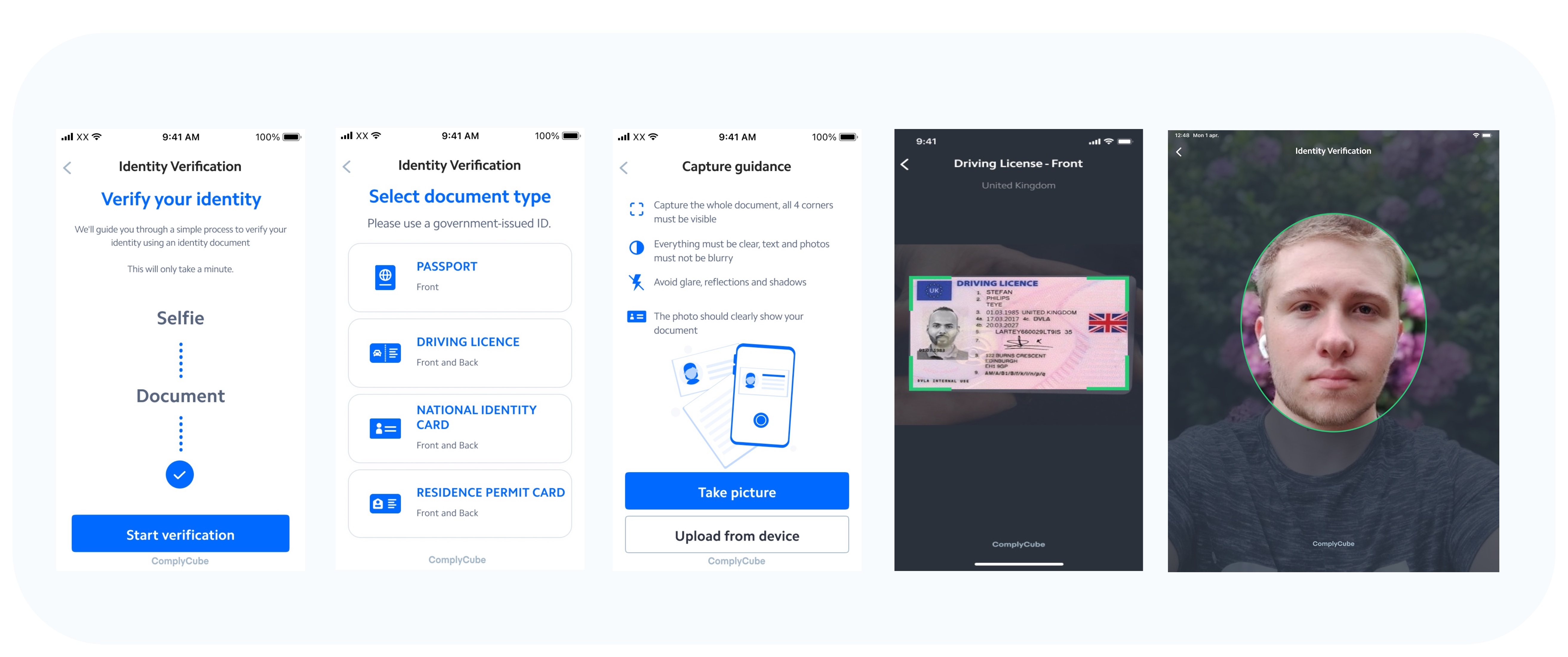
Mobile SDK View
circle-exclamation

Integration flow

The Mobile SDK runs on your mobile application, but relies on your backend to create secure tokens. Here’s how it works:

1

Create a client

Register a new client (i.e. customer) using the ComplyCube API.

2

Generate an SDK token

Your backend requests a JWT token tied to that client.

3

Initialize the SDK in your mobile app

Pass the token and settings to the SDK initializer.

4

Capture documents, videos, and selfies

The SDK guides your customer through the required steps.

5

Perform checks

Captured data is securely sent to ComplyCube for verification checks, and results are delivered in real time through the API or webhooks.

Mobile SDK Integration flow

Integration guide

Explore the source code and sample projects on our repository: GitHubarrow-up-right.

1

Install the SDK

  1. Before using the ComplyCube SDK, install the CocoaPods plugin by running the following command in your terminal:

  2. Add plugin repos and install the pod using your Podfile:

Application permissions

Our SDK uses the device camera and microphone for capture. You must add the following keys to your application Info.plist file.

  1. NSCameraUsageDescription

  1. NSMicrophoneUsageDescription

2

Create a client

Every verification flow starts with a client (i.e. customer). Use the API to create the client.

This must be done on your mobile app backend server, not the mobile app itself.

Example request

Example response

The response will contain an id (the Client ID). It is required for the next step.

circle-info

See Clients API Reference to learn more.

3

Generate an SDK token

Your backend must create an SDK token for each new flow. This token enable clients to send personal data securely from your mobile app to ComplyCube.

Tokens are short-lived and must not be reused.

Example request

Example response

circle-info

See SDK Token API Reference to learn more.

4

Prepare the stages

Set up the stages you wish to include in your flow.

5

Initialize the SDK

You can now initialize a flow. The sequence of stages you specify determines the order in which your client sees those stages.

6

Perform checks

Using the results returned in the onSuccess callback, you can trigger your mobile backend to run the necessary checks on your client.

For example, use the result of a selfie and document capture as follows:

Example request for a Document Check

If you have set up webhooks as described in our webhooks guidearrow-up-right, you will be notified once a check completes.

To retrieve the check results, you can perform a get check requestarrow-up-right.

7

Retrieve verification results

Your mobile backend can retrieve all check results using our API.

All our checks are asynchronous. If you have set up webhooks arrow-up-rightas described in our webhooks guidearrow-up-right, you will be notified once a check completes.

To retrieve the check results, you can perform a get check requestarrow-up-right.

Example request

Stages

Each stage in the flow can be customized to create the ideal journey for your customers.

The snippet below demonstrates how to set up a customized flow using the ComplyCube Mobile SDK.

Welcome

The Welcome screen is always shown first in the verification flow. It displays a welcome message along with a summary of the configured stages the user will complete.

You can customize the screen title to align with your app’s tone and branding.

This stage is used to collect explicit user consent before proceeding with the verification flow. It helps you meet regulatory and compliance requirements where applicable.

You can customize the screen title and message to match your legal or branding needs.

Selfie photo and video

You can request either a selfie photo (i.e. a Live Photo) or a selfie video (i.e. a Live Video) from the customer as part of the biometric verification process.

  • Photo: Captures a still image and performs a passive liveness check before allowing submission.

  • Video: Records a short video where the user completes an on-screen challenge (e.g. head movement or spoken phrase).

circle-exclamation

Document

The Document stage allows users to select and capture an identity document for verification (e.g. passport, ID card, residence permit). You can customize these screens to:

  • Limit the scope of document types the client can select, e.g., Passport only.

  • Set the document issuing countries they are allowed for each document type.

  • Add or remove automated capture using smart assistance.

  • Show or hide the instruction screens before capture.

  • Set a retry limit to allow clients to progress the journey regardless of capture quality.

circle-info

If you provide only one document type, the document type selection screen will be skipped. The country selection screen will be skipped if you provide only a single country for a given document type.

You can control whether instructional screens are shown before each camera capture by enabling or disabling guidance mode. Only disable guidance if your users are already clearly informed about the capture steps, as these screens help reduce user error and improve capture quality.

circle-info

Please note the retryLimit you set here will take precedence over the retry limit that has been set globally in your automation settingsarrow-up-right.

NFC capture

The ComplyCube mobile SDK supports NFC-based RFID chip reading for identity documents equipped with embedded chips. This allows for secure data extraction and high-assurance document authentication.

circle-info

Please get in touch with your Account Manager or supportarrow-up-right to get access to our NFC-enabled Mobile SDK.

Pre-requisites

circle-info

To use this feature, your app must have the Near Field Communication Tag Reading capability enabled. To add this capability to your app, refer to Apple's guide herearrow-up-right.

  1. Install the CocoaPods Artifactory plugin by running the following command in your terminal:

  2. To add the library, copy your repository credentials into a .netrc file to your home directory and setup the repository:

    Remember to fetch your credentials from JFrog using the Set Me Up button herearrow-up-right.

  3. Add plugin repos and install the pod using your Podfile:

  4. You must add the following keys to your application Info.plist file:

  1. To read NFC tags correctly, you need to add the following entries to your app target's Info.plist file:

Enabling NFC capture

Address capture

This stage allows users to manually enter their residential address. You can customize it to:

  • Restrict input to specific countries

  • Enable or disable the address autocomplete feature for faster and more accurate entry

Proof of address

This stage allows customers to submit a document verifying their residential address. You can configure which document types are accepted, such as utility bills or bank statements, and choose whether customers can upload a file or must capture the document live using their device camera.

circle-info

By default, this stage includes the address capture stage with autocomplete enabled to assist users during entry. Autocomplete can be disabled if not required.

Completion

You can include a completion stage at the end of the flow to confirm that the process has been successfully finished. This screen provides a clear end point for the user and can be customized to display a confirmation message or next steps.

Branding

The SDK allows you to customize the UI to match your application’s visual identity. You can define primary and accent colors during configuration to align the verification flow with your brand guidelines. Learn more about our appearance properties (see below).

Creating a custom appearance

Before initiating the flow, create your own custom design and integrate it into your Flow Builder.

Applying your custom appearance

Set the custom appearance that you have created using the Flow Builder.

chevron-rightAppearance propertieshashtag
Appearance Property
Description

primaryButtonBgColor

Primary action button background color.

primaryButtonTextColor

Primary action button text color.

primaryButtonBorderColor

Primary action button border color.

secondaryButtonBgColor

Secondary button background color.

secondaryButtonPressedBgColor

Secondary action button pressed background color.

secondaryButtonTextColor

Secondary action button text color.

secondaryButtonBorderColor

Secondary action button border color.

documentTypeSelectorBgColor

Document type selection button color.

documentTypeSelectorBorderColor

Document type selection button border color.

documentTypeSelectorTitleTextColor

Document type selection title text color.

documentTypeSelectorDescriptionTextColor

Document type selection description text color.

documentTypeSelectorIconColor

Document type selection icon color.

bodyTextColor

Screen body text color.

linkButtonTextColor

Links color.

headingTextColor

Title heading text color.

subheadingTextColor

Subheading text color.

infoPanelTitleColor

Information panel title color.

infoPanelDescriptionTextColor

Information panel description text color.

infoPanelBgColor

Information panel background color.

infoPanelIconColor

Information panel icon color.

errorPanelTitleColor

Error panel title color.

errorPanelDescriptionTextColor

Error panel description text color.

errorPanelBgColor

Error panel background color.

errorPanelIconColor

Error panel icon color.

cameraButtonBgColor

Camera capture button background color.

uiInterfaceStyle

Set the SDK to use dark mode, light mode, or system Inherited.

Localization

The SDK supports the languages listed below.

  • Arabic - ar 🇦🇪

  • Chinese (Simplified) - zh 🇨🇳

  • Chinese (Traditional) - hk 🇨🇳

  • Dutch - nl 🇳🇱

  • English - en 🇺🇸

  • French - fr 🇫🇷

  • German - de 🇩🇪

  • Hindi - hi 🇮🇳

  • Indonesian - id 🇮🇩

  • Italian - it 🇮🇹

  • Japanese - ja 🇯🇵

  • Korean - ko 🇰🇷

  • Norwegian - no 🇳🇴

  • Polish - po 🇵🇱

  • Portuguese - pt 🇵🇹

  • Spanish - es 🇪🇸

  • Swedish - sv 🇸🇪

  • Thai - th 🇹🇭

  • Vietnamese - vi 🇻🇳

Result handling

To manage the outcome of a verification session, you must implement the success, cancelled, and error callbacks.

On a successful completion (onSuccess), you can trigger check requestsarrow-up-right from your backend using the resource IDs returned in the result object. These IDs correspond to the uploaded assets (e.g. documents, selfies) and can be used to initiate verification checks via the ComplyCube API.

If the user exits the flow before completion, the onCancelled callback is invoked with a descriptive reason indicating why the session was cancelled (e.g. user exit, timeout, permission denied)

circle-info

In some cases, the customer may cancel the flow after completing one or more capture stages. If this occurs, any data captured prior to cancellation, such as documents or biometric media, may have already been uploaded to their client record.

If the SDK encounters an issue, the onError callback is triggered with a ComplyCubeError object containing the error type and message. Refer to the error codes (see below), for a full list of possible error cases.

chevron-rightError codeshashtag
Error Type
Description

BiometricStageCount

The configuration includes duplicate selfie photo or selfie video stages.

Cancelled

The client cancelled the flow and exited the SDK (triggered the onCancelled callback).

Connectivity

A network error has occurred.

DocumentMandatory

A document stage is required based on the configured stages but has not been included.

ExpiredToken

The SDK token has expired. Generate a new token and restart the flow.

FlowError

An unrecoverable error occurred during the flow.

InvalidCountryCode

An invalid country code was provided.

JailBroken

The SDK cannot run on this device because it has been jailbroken or compromised.

NoDiskAccess

The client denied disk access permissions required by the SDK.

NoDocumentTypes

A document stage was initialized without specifying any document types.

NoResult

No result was returned to the callback. If this persists, please contact support.

NoUserConsent

The client has not provided consent to proceed with the SDK flow.

NotAuthorized

The SDK attempted to access an endpoint it is not authorized to use.

Unknown

An unexpected error occurred. If this happens repeatedly, contact support.

UnsupportedCountryTypeCombination

The selected country and document type combination is not supported.

UnsupportedDocumentType

The provided document type is not supported.

UploadError

An error occurred while uploading a document or selfie.

UploadRequireGuidance

If useLiveCaptureOnly is set to false, guidance must be enabled by setting isGuidanceEnabled to true.

Events tracking

The SDK tracks a range of events throughout the verification flow, covering all key user interactions across stages. See below for the list of events.

If you need to implement custom analytics, you can hook into these events and trigger your own tracking logic accordingly.

To incorporate your own tracking, define a function and apply it using withEventHandler when initializing the FlowBuilder:

chevron-rightEventshashtag
Event

INTRO The client reached the intro screen.

CONSENT_STAGE The client reached the consent screen.

CONSENT_STAGE_WARNING The client attempted to exit without giving consent.

CAMERA_ACCESS_PERMISSION The client reached the camera permission request screen.

DOCUMENT_STAGE_CAPTURE_GUIDANCE The client reached the document capture guidance screen.

DOCUMENT_STAGE_DOCUMENT_TYPE The client has reached the document type selection screen for a document capture.

DOCUMENT_STAGE_SELECT_COUNTRY The client reached the country selection screen for a document capture.

DOCUMENT_STAGE_ONE_SIDE_CAMERA The client reached the capture camera stage for a one-sided ID document.

DOCUMENT_STAGE_ONE_SIDE_CAMERA_MANUAL_MODE The client reached the manual camera capture screen of a one-sided ID document.

DOCUMENT_STAGE_ONE_SIDE_CHECK_QUALITY The client reached the quality preview screen for a one-sided ID document.

DOCUMENT_STAGE_TWO_SIDE_CAMERA_FRONT The client reached the camera capture screen for the front side of a two-sided ID document.

DOCUMENT_STAGE_TWO_SIDE_CAMERA_FRONT_MANUAL_MODE The client reached the manual camera capture screen for the front side of a two-sided ID document.

DOCUMENT_STAGE_TWO_SIDE_CHECK_QUALITY_FRONT The client reached the quality preview screen for the front side of a two-sided ID document.

DOCUMENT_STAGE_TWO_SIDE_CAMERA_BACK The client reached the camera capture screen for the back side of a two-sided ID document.

DOCUMENT_STAGE_TWO_SIDE_CAMERA_BACK_MANUAL_MODE The client reached the manual camera capture screen for the back side of a two-sided ID document.

DOCUMENT_STAGE_TWO_SIDE_CHECK_QUALITY_BACK The client reached the quality preview screen for the back side of a two-sided ID document.

BIOMETRICS_STAGE_SELFIE_CAPTURE_GUIDANCE The client reached the selfie capture guidance screen.

BIOMETRICS_STAGE_SELFIE_CAMERA The client reached the selfie photo capture camera screen.

BIOMETRICS_STAGE_SELFIE_CAMERA_MANUAL_MODE The client reached the manual selfie photo capture camera screen.

BIOMETRICS_STAGE_SELFIE_CHECK_QUALITY The client reached the selfie capture photo review screen.

BIOMETRICS_STAGE_VIDEO_CAMERA The client reached the video selfie camera screen.

BIOMETRICS_STAGE_VIDEO_CAMERA_MANUAL_MODE The client reached the manual capture camera screen for a video selfie.

BIOMETRICS_STAGE_VIDEO_ACTION_ONE The client reached the first action in a video selfie capture.

BIOMETRICS_STAGE_VIDEO_ACTION_TWO The client reached the second action in a video selfie capture.

BIOMETRICS_STAGE_VIDEO_CHECK_QUALITY The client reached the manual selfie video capture camera screen.

PROOF_OF_ADDRESS_STAGE_CAPTURE_GUIDANCE The client reached the proof of address capture guidance screen.

PROOF_OF_ADDRESS_STAGE_DOCUMENT_TYPE The client reached the document type selection screen for a proof of address capture.

PROOF_OF_ADDRESS_STAGE_SELECT_COUNTRY The client reached the country selection screen for a proof of address capture.

PROOF_OF_ADDRESS_STAGE_ONE_SIDE_CAMERA The client reached the capture camera stage for a one-sided proof of address document.

PROOF_OF_ADDRESS_STAGE_ONE_SIDE_CAMERA_MANUAL_MODE The client reached the manual capture camera stage for a one-sided proof of address document.

PROOF_OF_ADDRESS_STAGE_ONE_SIDE_CHECK_QUALITY The client has reached the quality preview screen for a one-sided proof of address document.

PROOF_OF_ADDRESS_STAGE_TWO_SIDE_CAMERA_FRONT The client reached the capture camera stage for the front side of a two-sided proof of address document.

PROOF_OF_ADDRESS_STAGE_TWO_SIDE_CAMERA_FRONT_MANUAL_MODE The client reached the manual capture camera stage for the front side of a two-sided proof of address document.

PROOF_OF_ADDRESS_STAGE_TWO_SIDE_CHECK_QUALITY_FRONT The client reached the quality preview screen for the front side of a two-sided proof of address document.

PROOF_OF_ADDRESS_STAGE_TWO_SIDE_CAMERA_BACK The client reached the capture camera stage for the back side of a two-sided proof of address document.

PROOF_OF_ADDRESS_STAGE_TWO_SIDE_CAMERA_BACK_MANUAL_MODE The client reached the manual capture camera stage for the back side of a two-sided proof of address document.

PROOF_OF_ADDRESS_STAGE_TWO_SIDE_CHECK_QUALITY_BACK The client reached the quality preview screen for the back side of a two-sided proof of address document.

COMPLETION_STAGE The client has reached the completion screen.

Token expiry handling

To handle token expiration gracefully, you can provide a callback function that generates a new SDK token when needed. This allows the flow to continue seamlessly without requiring the user to restart the session manually.